EXPERIMENT OVERVIEW
The experiment focuses on improving well-being & safety of workers in high-precision manufacturing sectors, such as medical devices, wearables & electronics. Workers in these environments perform detailed assembly tasks that demand focus, accuracy and physical endurance.
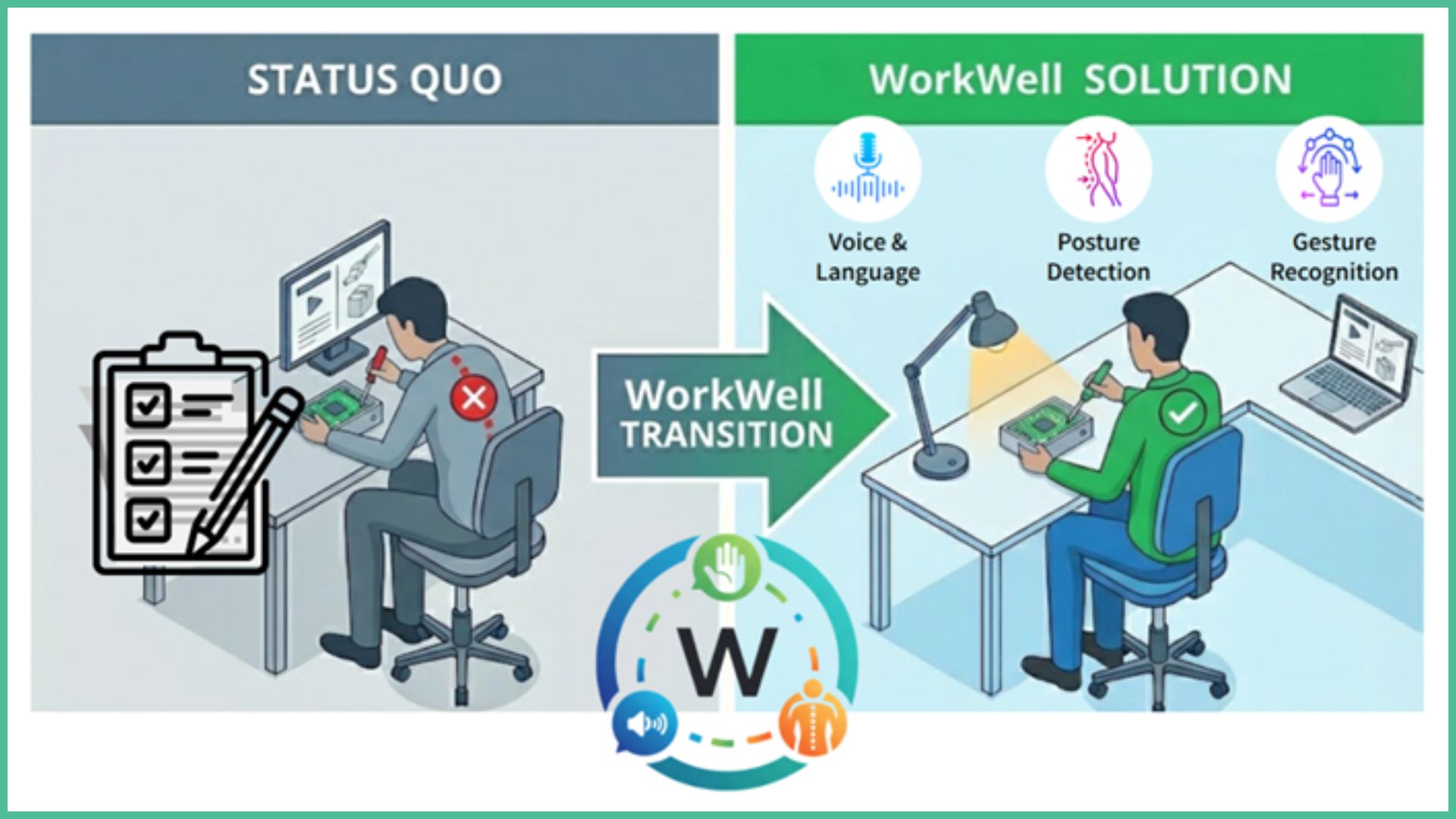
We develop and validate the WorkWell Assistant, a conversational Digital Intelligent Assistant (DIA) designed to support workers directly on the shop floor. The system follows a modular approach that combines voice-based interaction with visual perception capabilities, enabling touch-free communication, context-aware guidance and accessible feedback without interrupting ongoing work processes.
The experiment brings together expertise in artificial intelligence, edge computing and medical device manufacturing to evaluate the assistant under real-world conditions. The goal is to demonstrate technical feasibility and evaluate user experience, interaction quality and privacy-aware deployment in real manufacturing environments.
High-precision assembly environments require sustained concentration, fine motor control, and prolonged static postures. Workers may experience physical strain, fatigue or reduced ergonomic comfort during repetitive tasks, while maintaining strict quality requirements. Supporting worker wellbeing without disrupting established workflows remains a significant challenge.
Currently, finding the right support tools for these specific environments is difficult for many SMEs. Traditional monitoring systems are often costly, technically complex or difficult to integrate into agile SME environments, while standard training materials and safety instructions tend to be static and provide no contextual or real-time support during work. Furthermore, generic voice assistants often rely on cloud processing, which raises concerns regarding latency, reliability and data privacy.
As a result, there is a lack of accessible, privacy-first technologies that align with operational realities and support worker wellbeing without compromising established processes or data protection expectations.
Objective 1: Human-centred multi-channel worker support
The project aims to explore how a conversational digital assistant can support workers’ well-being and situational awareness during precision assembly tasks. The assistant combines voice-based interaction with selected vision-supported features to enable touch-free use, accessible feedback and context-aware guidance. It is designed to integrate naturally into existing workflows without interrupting the working process. The system will follow a modular architecture that allows flexible configuration and future extension, while enabling adaptation to different workplace needs without changing the core interaction experience.
Objective 2: Scalability and long-term sustainability
This objective focuses on preparing the WorkWell OVOS Skill for broader adoption and distribution through the WASABI ecosystem. It will be packaged as a modular deployment so that it can be integrated and adapted by other European SMEs according to their specific needs. The approach supports long-term sustainability by providing a structured framework that allows future extensions without requiring fundamental redesign.
Objective 3: Trustworthy and privacy-first AI deployment
The project places strong emphasis on privacy, transparency and ethical AI practices. The assistant is designed to operate primarily on local edge devices, reducing dependency on cloud processing and supporting GDPR-aligned data handling. This objective focuses on demonstrating that conversational and multi-channel AI systems can be implemented in a way that respects user trust while remaining technically practical.
The experiment takes place in the context of high-precision manufacturing. These environments require consistent procedures, careful handling of materials, and adherence to strict quality and safety requirements. Workers often perform repetitive or fine-motor tasks that demand sustained concentration and static postures. In many cases, the use of protective equipment or specialised work attire further limits conventional interaction methods such as touch-based interfaces, reinforcing the need for accessible and non-intrusive interaction modalities.
The pilot is carried out together with our manufacturing partner who is experienced in regulated medical device production environments. The experiment focuses on an assembly process involving wearable devices and sensitive electronic components. It examines how a conversational Digital Intelligent Assistant (DIA) can be introduced as a supportive layer within existing workflows. Particular attention is given to privacy-by-design principles, user acceptance and maintaining a non-intrusive interaction model.
Primary users are assembly workers performing detailed tasks, while stakeholders include technical teams and organisational decision-makers interested in practical approaches to human-centred digitalisation. The exploration seeks to better understand how such assistants are perceived in everyday work contexts and what conditions support meaningful adoption.
EXPECTED IMPACT
EXPECTED IMPACT
The most important impact we aim to achieve is to improve the wellbeing and daily working experience of people involved in high-precision manufacturing. The experiment focuses on ergonomic support by enabling hands-free access to guidance and interaction during demanding assembly tasks. The assistant is intended to contribute to a more supportive working environment by encouraging ergonomic awareness, making interaction intuitive and allowing workers to stay engaged with their tasks while maintaining comfort.
Success will be assessed through a combination of human-centred and technical indicators. On the human-centric side, evaluation focuses on worker acceptance, perceived usefulness and overall satisfaction. From a technical perspective, we examine practical indicators like stable interaction behaviour, integration within the modular architecture and feasibility for deployment into operational workflows.
For organisations, the expected benefit is practical insight into how privacy-aware, edge-based assistants can be introduced in ways that encourage worker acceptance without requiring major infrastructure changes. The WorkWell OVOS skill provides a modular foundation that supports continued development and allows for adaptation to specific operational needs. Beyond the project itself, the work aligns with broader Industry 5.0 developments by exploring human-centred and privacy-conscious digitalisation approaches with potential relevance for future implementations.
GALLERY