
EXPERIMENT OVERVIEW
During the footwear manufacturing process, a significant volume of EVA (Ethylene-Vinyl Acetate) waste accumulates (sprues, textile cuttings, non-conforming products), which is often disposed of or sold at a low price instead of being reused. Insufficient real-time control of process parameters and errors in equipment temperature regimes, pressure, or volume lead to defective products, while the lack of automated analytics forces technologists to rely on delayed manual reports, reducing the effectiveness of response to malfunctions. An additional challenge is the increase in energy consumption caused by inefficient heating and cooling regimes.
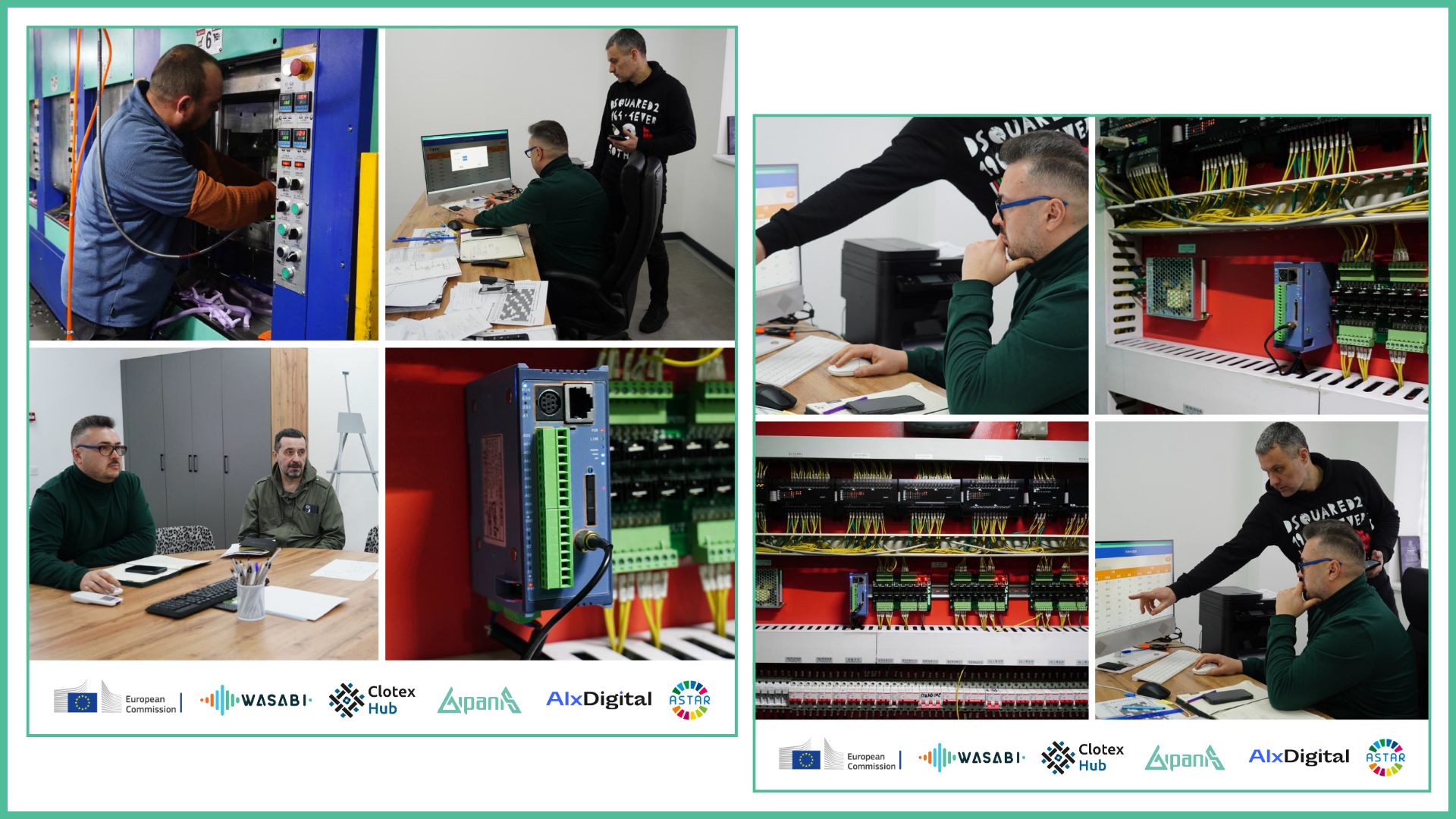
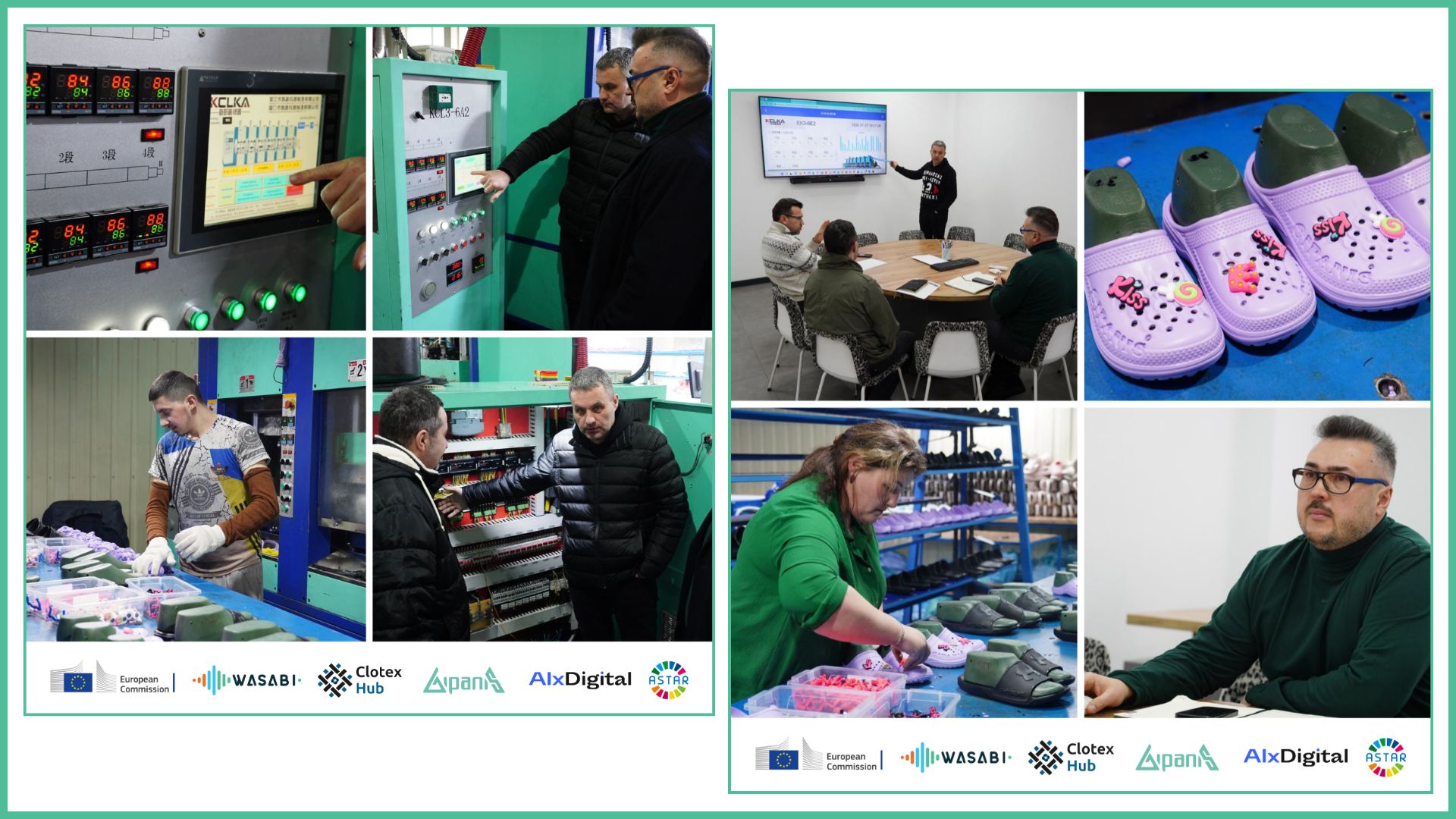
The CIRC-SHOE project is aimed at comprehensively addressing these challenges. The main production line for the experiment is the KCLKA EK3-6E2 injection molding machine, which is used to process EVA polymer into soles, insoles, clogs, boots, and other types of footwear at the manufacturing enterprise LLC “Vzuttia Podillia.” It is on this line that the Digital analytics and forecasting of potential deviations that may lead to defects or overconsumption, as well as management of EVA waste through its identification and systematization for reuse. In addition, AI-WVMA will provide automated notifications to the technological department about equipment malfunctions and deviations in operating modes. Our AI-WVMA tool will also be suitable for other equipment in the light industry, as it is based on universal algorithms for monitoring production parameters (temperature, volumes, energy consumption, defect rates) that are typical for most light-industry equipment and therefore can be easily adapted to various technological processes.
The implementation of AI-WVMA in the company’s production processes will lead to significant improvements. In particular, EVA waste will be reduced by 8–10% through monitoring and reuse of secondary raw materials; production costs will decrease by 5–8% due to process optimization and loss reduction; energy consumption per unit of product will be reduced by 3% through more precise control of molding and cooling regimes; production culture will improve through better plan control, compliance with technological requirements, and rapid response to deviations; product quality will increase and the defect rate will decrease; automated notification of the technological department will occur in 95% of equipment failure cases, reducing production downtime. Overall, this will result in a sustainable environmental effect: reduced waste volumes, lower CO₂ emissions, and compliance with Green Deal principles. The primary beneficiaries of CIRC-SHOE will be the employees of LLC “Vzuttia Podillia” (200 staff members), of whom 15–20 technologists, mechanics, and operators will gain access to the real-time parameter monitoring system. This will enable a reduction in defect rates by 8–10% and a decrease in energy consumption by 3%.
For the company’s management, the expected impact includes a 5–8% reduction in production costs and increased competitiveness of the GIPANIS brand, with a projected export growth of 4–5%.
Secondary beneficiaries will include other SMEs in the light industry in Ukraine and the EU—ranging from hundreds of companies in Ukraine (approximately 510 enterprises) to around 1,000 in the EU. This could lead to a reduction of 1,000–1,500 tons of waste annually, a decrease in defect rates by 9–12%, and an improvement in energy efficiency by 4–6%.
In the Khmelnytskyi region, where more than 1,000 light industry enterprises operate, a multiplier effect is expected: 8–12 companies may implement the DIA within two years, contributing to waste reduction of 8–10% and energy cost savings of 3–5%.
Thus, CIRC-SHOE has the potential not only for local but also for systemic impact, establishing a new standard for waste management in footwear and textile manufacturing. The project transforms the approach from disposal to valorization of EVA waste, making production more sustainable, flexible, and competitive.
The CIRC-SHOE experiment addresses a set of interlinked operational, technical, data, and sustainability challenges typical for EVA footwear production based on injection moulding. At the host SME (ТОВ «Взуття Поділля», TM GIPANIS), key production outcomes—output volume, scrap and defect rates, temperature stability of moulds/injector, and energy consumption—are strongly influenced by machine settings and process conditions that can fluctuate during shifts. When deviations are detected late, the result is avoidable waste: EVA runners/sprues, nonconforming parts, and rework that consumes additional time, energy, and raw material.
A core pain point is the lack of real-time visibility and early warning. Process data is often monitored locally at the machine or captured manually, while consolidated reporting is delayed and fragmented. This creates a “reaction gap”: technologists and mechanics learn about drift in temperature regimes, oil temperature, injection parameters, or abnormal energy patterns after defects have already accumulated or a machine has already operated inefficiently for hours. In practice, this leads to unstable quality, higher defect rates, and additional material losses, especially when multiple product types (soles, insoles, sabo, boots) are produced under varying mould and cycle conditions.
Another challenge is inefficient use and low-value handling of EVA waste. In footwear manufacturing, EVA waste streams (sprues/runners, trimming residues, nonconforming products) are frequently disposed of or sold at low value because there is insufficient traceability of waste origin, composition, and quality, and limited operational support for systematic reuse. Without structured accounting and analytics, it is difficult to identify which waste fractions are suitable for safe reintegration into production, how reuse affects quality, and what process adjustments are needed to maintain consistent output.
Energy consumption is a further critical issue. EVA injection moulding is energy intensive due to heating/cooling cycles, temperature maintenance, and downtime losses. When heating and cooling regimes are not optimized—especially under frequent changeovers or suboptimal temperature control—energy per unit increases and indirectly raises the carbon footprint of each pair produced. For SMEs facing volatile energy prices and competitiveness pressure, even small percentage improvements translate into meaningful cost savings and resilience.
The experiment also addresses a data-related and technical integration barrier: industrial data exists but is not turned into actionable intelligence. Sensor and controller signals (temperatures, cycles, energy readings, alarms) are typically stored in proprietary formats or remain unused beyond basic monitoring. SMEs often lack the tooling and expertise to collect time-series data reliably, normalize it, and apply descriptive/predictive analytics to detect anomalies and prevent defects. As a result, decision-making remains heavily dependent on individual experience, and process optimization is not reproducible across shifts or product batches.
Regulatory and trust considerations matter as well, especially as SMEs increasingly align with EU sustainability expectations and digital governance. Even when the system focuses on production data rather than personal data, it must demonstrate robust cybersecurity, role-based access, auditability, and transparent human oversight. In addition, any AI-enabled support tool must be deployed in a way that aligns with GDPR principles and a risk-based approach consistent with the EU AI Act—avoiding autonomous control of equipment, ensuring clear user awareness of AI involvement, logging actions, and enabling escalation to responsible staff in critical cases.
Finally, the challenge has a broader sustainability and market relevance. Reducing EVA waste and improving energy efficiency supports circularity goals and improves the environmental profile of products—an increasingly important factor for supply chains and customers seeking “greener” manufacturing. For Ukrainian and EU footwear SMEs, a replicable digital assistant that reduces scrap, energy use, and process variability can become a practical pathway to strengthen competitiveness while advancing Green Deal–aligned production practices.
Objective 1:
The first objective is to design, implement, and operationalize the AI Waste Valorization & Monitoring Assistant (AI-WVMA) as a Digital Intelligent Assistant (DIA) integrated into the EVA injection moulding line at LLC «Vzuttia Podillia». The system will collect and process time-series production data (output, defect rate, temperature regimes, energy consumption, and related parameters), provide real-time dashboards and alerts, and apply descriptive and predictive analytics to detect deviations and support timely human decision-making—without autonomous control of equipment.
Objective 2:
The second objective is to achieve measurable improvements in production efficiency and sustainability by using AI-driven analytics to optimize process parameters and enable structured EVA waste valorization. Within 12 months, the experiment aims to reduce EVA waste by 8–10%, decrease energy consumption per unit by at least 3%, increase the share of reusable EVA waste to at least 8%, and lower overall production costs by 5–8% through reduced scrap, improved stability of temperature regimes, and more efficient resource use.
Objective 3:
The third objective is to validate the technical, operational, and business feasibility of AI-WVMA in a real industrial environment and prepare it for broader deployment via the WASABI ecosystem and EDIH networks. This includes documenting the architecture, ensuring compliance with GDPR and a risk-based approach under the EU AI Act, developing a sustainable exploitation and business model, and publishing the solution as a replicable module that can be adapted by other footwear and light industry SMEs in Ukraine and the EU.
The experiment takes place in the context of high-precision manufacturing. These environments require consistent procedures, careful handling of materials, and adherence to strict quality and safety requirements. Workers often perform repetitive or fine-motor tasks that demand sustained concentration and static postures. In many cases, the use of protective equipment or specialised work attire further limits conventional interaction methods such as touch-based interfaces, reinforcing the need for accessible and non-intrusive interaction modalities.
The pilot is carried out together with our manufacturing partner who is experienced in regulated medical device production environments. The experiment focuses on an assembly process involving wearable devices and sensitive electronic components. It examines how a conversational Digital Intelligent Assistant (DIA) can be introduced as a supportive layer within existing workflows. Particular attention is given to privacy-by-design principles, user acceptance and maintaining a non-intrusive interaction model.
Primary users are assembly workers performing detailed tasks, while stakeholders include technical teams and organisational decision-makers interested in practical approaches to human-centred digitalisation. The exploration seeks to better understand how such assistants are perceived in everyday work contexts and what conditions support meaningful adoption.
EXPECTED IMPACT
EXPECTED IMPACT
The expected impact of the CIRC-SHOE experiment is technological, economic, and environmental, with measurable improvements at the level of production efficiency, waste reduction, and energy performance. Success will be determined by comparing baseline production indicators (collected during WP1) with post-implementation results after full deployment and pilot validation (WP3–WP4), using clearly defined KPIs.
At the operational level, the primary expected impact is improved process stability and reduced defect rates in EVA injection moulding. Based on historical internal production data, the current defect rate in EVA production fluctuates within a defined baseline range (to be formally documented during WP1). Through real-time monitoring, anomaly detection, and predictive alerts, the experiment aims to reduce EVA-related waste and defects by 8–10% within 12 months. Success will be measured through monthly scrap reports, percentage of nonconforming products, and reduction in unplanned parameter deviations per shift.
In terms of resource efficiency and sustainability, the experiment aims to reduce energy consumption per unit of output by at least 3%, measured in kWh per pair (or per production batch). Baseline energy intensity will be established from historical utility and machine-level data. Additionally, the project targets an increase in the structured reuse of EVA waste to at least 8% of total EVA residues, transitioning from low-value disposal toward controlled reintegration into production where quality allows. Environmental impact will be assessed through reductions in material waste (kg/month), energy intensity (kWh/unit), and estimated CO₂ emissions linked to electricity consumption.
For end users—technologists, operators, and mechanics—the expected benefit is improved visibility and faster decision-making. Instead of relying on delayed manual reports, staff will receive real-time dashboards and automated alerts in at least 95% of parameter deviation cases. Success will be measured through system log data (alert accuracy and response times), reduction in reaction lag between deviation detection and corrective action, and qualitative feedback collected from users during pilot evaluation. Improved transparency is expected to reduce unplanned downtime and improve adherence to technological regimes.
From a business perspective, the reduction in scrap and energy use is expected to decrease production costs by 5–8%, strengthening the competitiveness of TM GIPANIS in both domestic and EU markets. This will be evaluated through cost-per-unit analysis before and after implementation. For the IT partner and DIH, success will also be measured by the readiness of the solution for replication: completion of technical documentation, publication within the WASABI ecosystem, and demonstrated transferability to at least one additional SME use case scenario.
Overall, the experiment will be considered successful if it demonstrates:
- ≥5% reduction in EVA waste,
- ≥3% reduction in energy consumption per unit,
- ≥8% structured reuse of EVA residues,
- ≥95% automated detection and notification of critical deviations,
- measurable cost reduction (5–8%), and
- validated readiness for replication across light industry SMEs.
These quantitative KPIs, combined with user validation and documented compliance with GDPR and a risk-based AI governance approach, will confirm that CIRC-SHOE delivers tangible industrial, environmental, and strategic value.
GALLERY