EXPERIMENT OVERVIEW
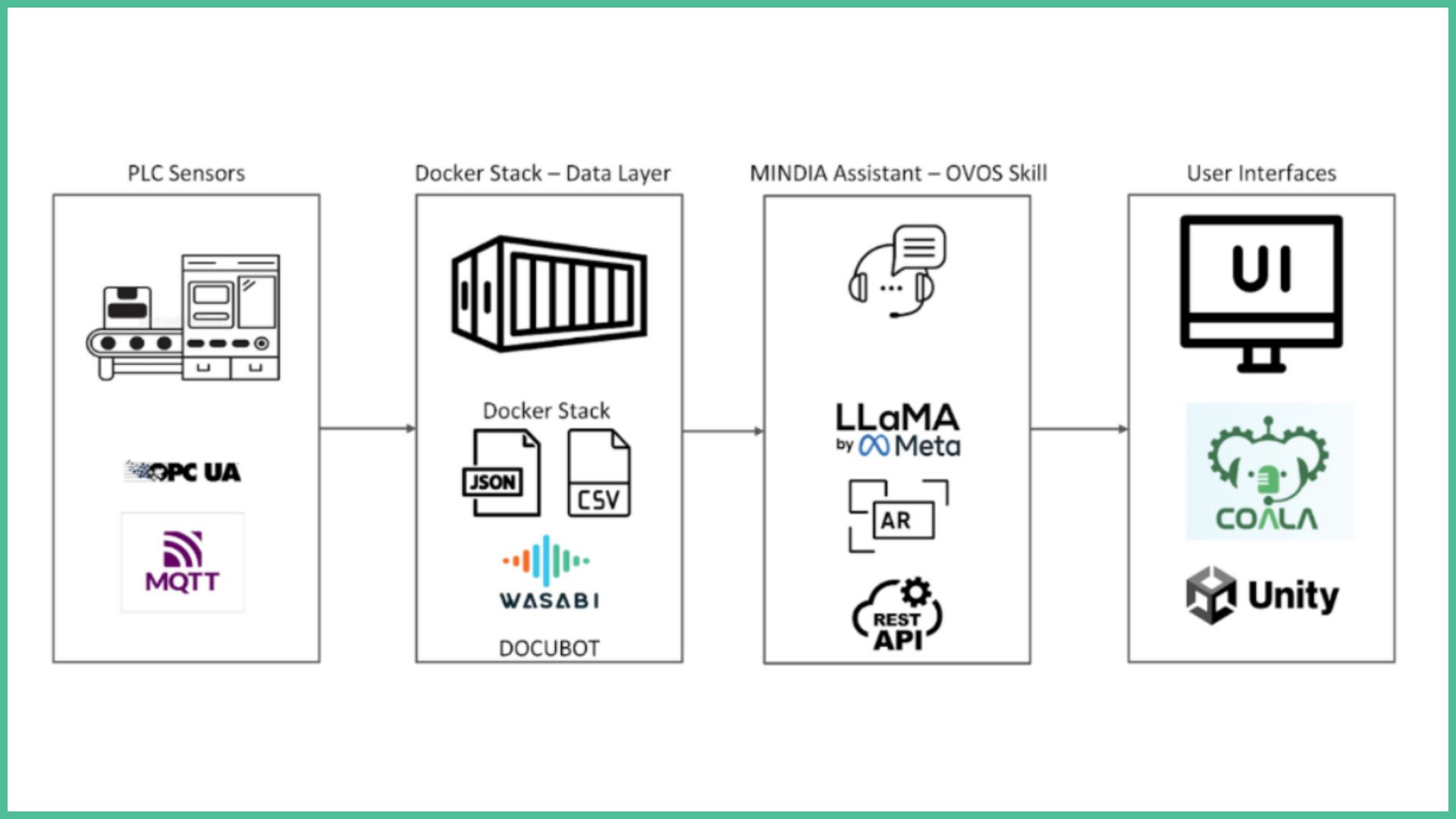
The MINDIA (Manufacturing Intelligent Digital Assistant) experiment focuses on designing, deploying, and validating a multimodal digital assistant tailored for real-time decision support and operator assistance in the plastics manufacturing environment. The primary objective is to bridge the gap between fragmented operational data and real-time shop-floor decision-making by turning scattered experience and static documentation into an accessible, intelligent interface. This solution is built around the WASABI ecosystem and is implemented as an Open Voice OS (OVOS) based digital assistant, which is deployed through a containerized infrastructure using Docker Compose. To ensure a robust data integration layer, the system utilizes standard industrial communication protocols, specifically Open Platform Communications Unified Architecture (OPCUA) and Message Queuing Telemetry Transport (MQTT), to collect real-time machine and sensor data.
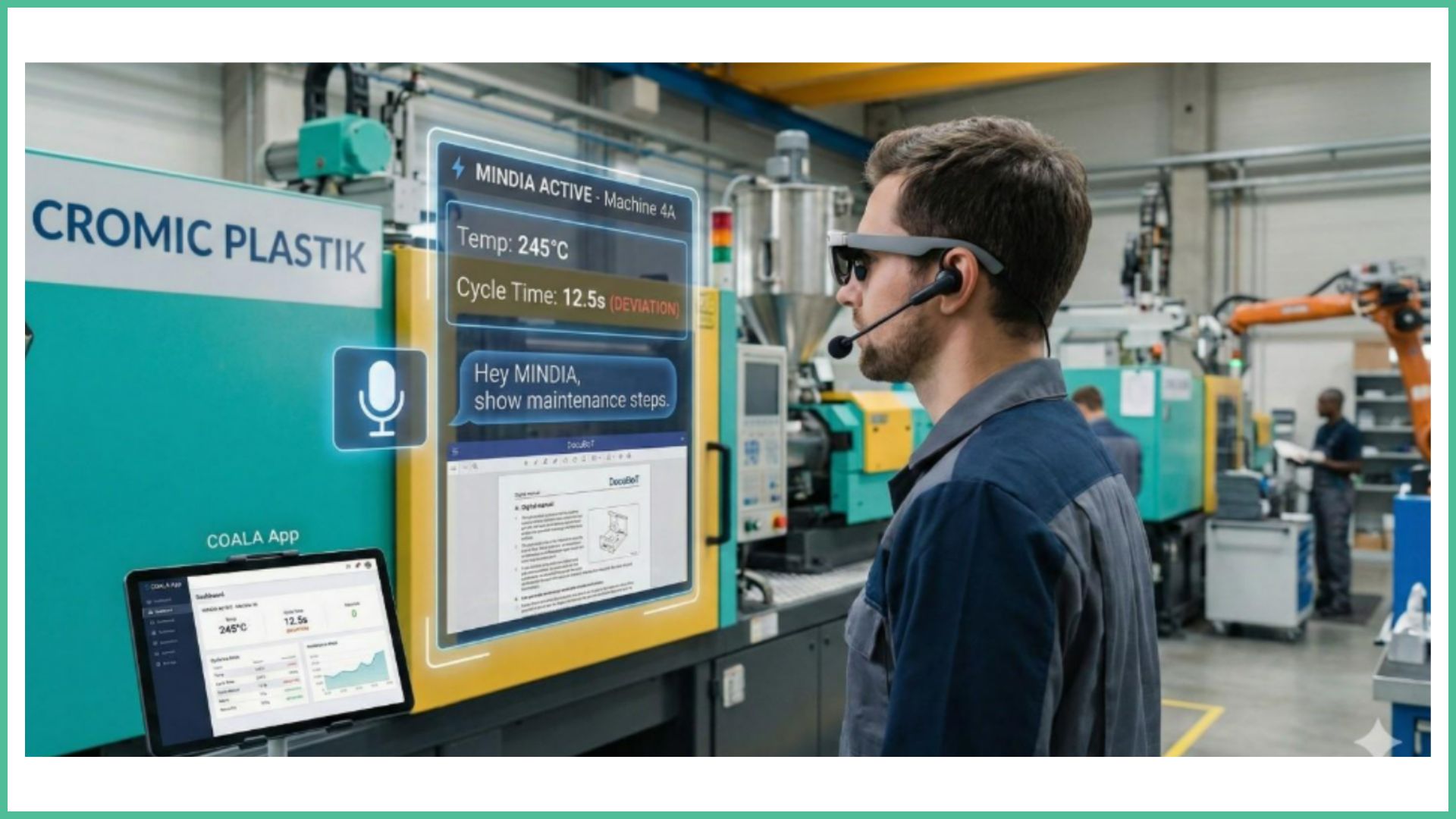
The assistant significantly enhances operator efficiency by connecting to a specialized component called DocuBoT, which enables users to query technical manuals, material specifications, and operational guidelines using natural language. This allows for instant summarization and contextual retrieval of information, ensuring that operators can access critical instructions without interrupting their manual tasks. During the experiment, the system will demonstrate realtime monitoring of production deviations and a streamlined scrap management workflow. Interaction is primarily designed to be hands-free through voice commands, but it also supports visual guidance via Augmented Reality (AR) interfaces on mobile devices or lightweight glasses, such as Xreal, through the COALA application.
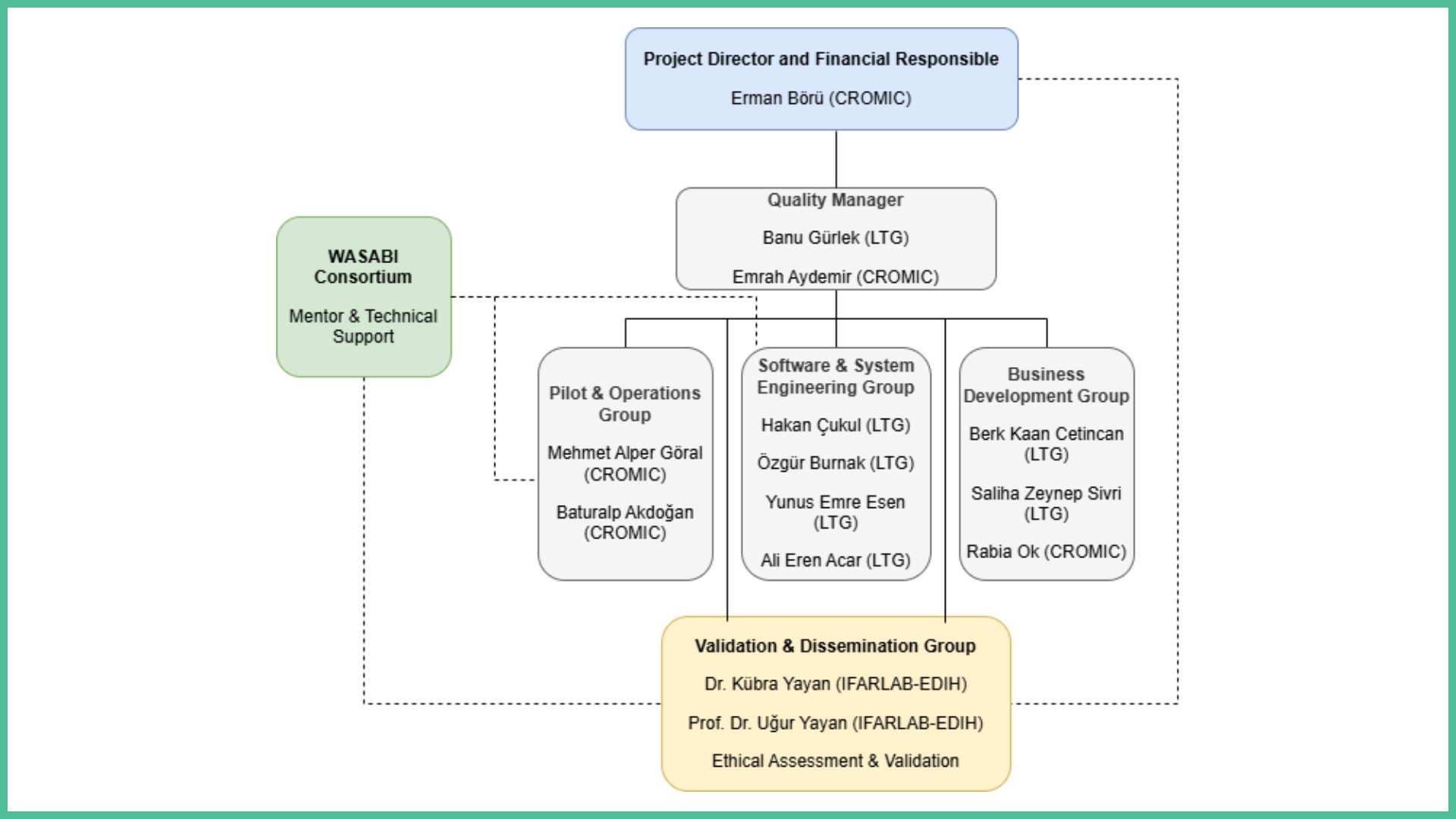
This effort is a collaborative project involving three specialized partners: Cromic Plastik serves as the industrial coordinator and provides the real-world manufacturing environment for validation; Lider Teknoloji Geliştirme (LTG) acts as the technical developer responsible for software design and system integration; and Eskişehir Osmangazi University Intelligent Factory and Robotics Laboratory (IFARLAB-EDIH) provides scientific guidance and ethical validation. MINDIA is highly relevant to modern manufacturing as it supports the transition to Industry 5.0 and adheres to Trustworthy Artificial Intelligence principles by prioritizing human oversight and sustainability. Ultimately, the validated solution will be packaged and distributed via the WASABI White Label Shop to ensure that the outcomes are market-ready and easily replicable by other Small and Medium-sized Enterprises across Europe.
Before implementing the MINDIA experiment, Cromic operates its manufacturing processes using largely manual and fragmented workflows where production-related information is distributed across multiple systems, physical documents, and informal communication channels. This fragmentation limits real-time visibility on the shop floor and makes timely decision-making difficult because there are no integrated tools to support the operators. Consequently, process deviations or equipment issues are often detected only after manual inspections or routine checks, resulting in slow response times, increased downtime, and a higher likelihood of scrap generation before any corrective actions can be taken.
Operators currently rely heavily on printed manuals or the verbal experience of colleagues to interpret faults, which makes identifying the root cause of an issue time-consuming and dependent on individual expertise. Accessing operational knowledge is inefficient because the necessary information is typically stored in static documents dispersed across different systems, making it difficult to retrieve during active production. As a result, operators must frequently interrupt their manual tasks to search for guidance, which increases their cognitive load and heightens the risk of human error.
From a sustainability perspective, the lack of structured and digital reporting for material usage and scrap events hinders the company’s ability to implement timely corrective measures. Communication with the logistics department regarding mold and color changes is entirely manual, leading to significant delays in scrap collection and recycling coordination. These systemic challenges negatively impact production costs and resource utilization, highlighting a critical need for a digital solution that can transform scattered experience and static documentation into an accessible, intelligent interface.
Objective 1:
The primary technical objective of the MINDIA experiment is to develop and validate a multimodal Digital Intelligent Assistant (DIA) that integrates real-time machine monitoring, voice-based interaction, and augmented reality (AR) visualization to support manufacturing operations. By leveraging Open Voice OS (OVOS) and Large Language Model (LLM) reasoning, the project aims to turn scattered production data and operational experience into an accessible, intelligent interface that provides operators with hands-free, context-aware guidance. This integration is designed to bridge the gap between theoretical plans and field execution, significantly reducing operator cognitive load while accelerating response times to production deviations by an estimated 30%.
Objective 2:
The second objective is to enhance sustainability and operational efficiency within the plastics manufacturing sector through optimized resource management and improved process transparency. MINDIA targets measurable improvements in material usage, specifically aiming for a 10% reduction in raw material consumption and a 5% increase in the recovery of recyclable materials through structured scrap reporting and real-time alerts. By enabling the early detection of inefficiencies and fostering human-AI collaboration, the experiment promotes a more sustainable and productive shop-floor environment that maintains full human oversight in line with Industry 5.0 principles.
Objective 3: Trustworthy and privacy-first AI deployment
The final objective is to ensure the scalability and market-readiness of the developed solution by packaging MINDIA as a reusable, open-source asset for distribution via the WASABI White Label Shop. The experiment validates how a domain-specific manufacturing assistant can be containerized and successfully deployed in real industrial conditions, providing a replicable blueprint for other SMEs to adopt with minimal integration effort. By demonstrating the commercial viability and technological maturity of open-source components within the WASABI ecosystem, the project supports the broader goal of fostering human-centered digital transformation and digital sovereignty across European manufacturing.
The MINDIA experiment is situated within the plastics manufacturing sector, a field that increasingly requires high levels of process awareness and efficient material management to remain competitive. The experiment will be conducted at the industrial facilities of Cromic Plastik in Eskişehir, Turkey, which serves as the primary pilot site. While initial development and functional testing take place in the controlled laboratory environment of IFARLAB-EDIH, the core of the experiment involves a real-world pilot deployment on the production floor. This setting allows the system to be validated under actual operating conditions, focusing on specific production lines where material waste and process deviations have the highest impact.
The target users for this digital assistant are shop-floor operators and production supervisors who require instant, hands-free access to machine data and technical documentation during their daily tasks. Key stakeholders include the MINDIA consortium partners—Cromic Plastik as the industrial coordinator, Lider Teknoloji Geliştirme (LTG) as the technology provider, and IFARLAB-EDIH as the scientific advisor, as well as the broader WASABI consortium, which provides the underlying architectural framework. These stakeholders are collectively invested in proving that AI-driven tools can enhance operator performance while maintaining human-centered control in an industrial environment.
Operating in a real manufacturing environment introduces several critical constraints and requirements that the MINDIA solution must address. From a safety perspective, the system is designed for fully hands-free voice interaction to ensure that operators can receive guidance without diverting their attention from dangerous machinery or interrupting manual tasks. Technical development follows rigorous engineering standards, including IEEE 12207 and AQAP2210, while the AI deployment is governed by the EU AI Act and GDPR to ensure ethical and trustworthy operation. Furthermore, the solution must seamlessly integrate with existing factory systems via OPC-UA and MQTT protocols and operate within the secure, containerized WASABI Docker Compose stack to maintain data integrity and role-based access control.
The pilot is carried out together with our manufacturing partner who is experienced in regulated medical device production environments. The experiment focuses on an assembly process involving wearable devices and sensitive electronic components. It examines how a conversational Digital Intelligent Assistant (DIA) can be introduced as a supportive layer within existing workflows. Particular attention is given to privacy-by-design principles, user acceptance and maintaining a non-intrusive interaction model.
Primary users are assembly workers performing detailed tasks, while stakeholders include technical teams and organisational decision-makers interested in practical approaches to human-centred digitalisation. The exploration seeks to better understand how such assistants are perceived in everyday work contexts and what conditions support meaningful adoption.
EXPECTED IMPACT
EXPECTED IMPACT
The MINDIA experiment is situated within the plastics manufacturing sector, a field that increasingly requires high levels of process awareness and efficient material management to remain competitive. The experiment will be conducted at the industrial facilities of Cromic Plastik in Eskişehir, Turkey, which serves as the primary pilot site. While initial development and functional testing take place in the controlled laboratory environment of IFARLAB-EDIH, the core of the experiment involves a real-world pilot deployment on the production floor. This setting allows the system to be validated under actual operating conditions, focusing on specific production lines where material waste and process deviations have the highest impact.
The target users for this digital assistant are shop-floor operators and production supervisors who require instant, hands-free access to machine data and technical documentation during their daily tasks. Key stakeholders include the MINDIA consortium partners—Cromic Plastik as the industrial coordinator, Lider Teknoloji Geliştirme (LTG) as the technology provider, and IFARLAB-EDIH as the scientific advisor, as well as the broader WASABI consortium, which provides the underlying architectural framework. These stakeholders are collectively invested in proving that AI-driven tools can enhance operator performance while maintaining human-centered control in an industrial environment.
Operating in a real manufacturing environment introduces several critical constraints and requirements that the MINDIA solution must address. From a safety perspective, the system is designed for fully hands-free voice interaction to ensure that operators can receive guidance without diverting their attention from dangerous machinery or interrupting manual tasks. Technical development follows rigorous engineering standards, including IEEE 12207 and AQAP2210, while the AI deployment is governed by the EU AI Act and GDPR to ensure ethical and trustworthy operation. Furthermore, the solution must seamlessly integrate with existing factory systems via OPC-UA and MQTT protocols and operate within the secure, containerized WASABI Docker Compose stack to maintain data integrity and role-based access control.
GALLERY