Elvez - Company and Team
Elvez is an advanced manufacturing company specialised in providing clients worldwide with plastic injection components, metallised parts and cable harness solutions. The company provides a wide range of low to high volume multi-use injection moulding services, PVD metallised parts and complex made-to-measure cable harness solutions. From concept to production and assembly, we deliver quality components to a wide range of challenging global industries such as automotive manufacturers, general consumer products, industrial and technical, white goods and more. For 30 years we have prided ourselves by offering complete turn key solutions in which our expertise, quality assurance and ingenuity guarantee our philosophy of constant “manufactured excellence delivered”.
EXPERIMENT OVERVIEW
OVERVIEW
The experiment focuses on improving the onboarding process for new employees in complex manufacturing systems by integrating advanced digital technologies, specifically Human–Machine Interaction (HMI) and conversational artificial intelligence (AI). With this approach, we aim to modernize and streamline training, enhancing both efficiency and effectiveness in manufacturing environments. Our production operations are divided into two sectors: plastic injection molding and wire harness assembly.
Traditional onboarding is highly dependent on knowledge transfer, which can lead to variability in training quality and place additional pressure on senior workers. The introduction of a digital intelligent assistance (DIA) and virtual reality (VR) based training enables more consistent and structured knowledge transfer, reducing the training burden on experienced workers.
The ONBOARDING-AI experiment addresses the training challenges associated with these complex manufacturing processes, which involve intricate tasks and specialized machinery.
The experiment utilized HMI technology to create a digital training platform that simulates real-world manufacturing tasks. This includes interactive interfaces and virtual simulations that allow new employees to practice and learn in a controlled environment. Conversational AI has been integrated into the training platform to provide real-time guidance, feedback, and support.
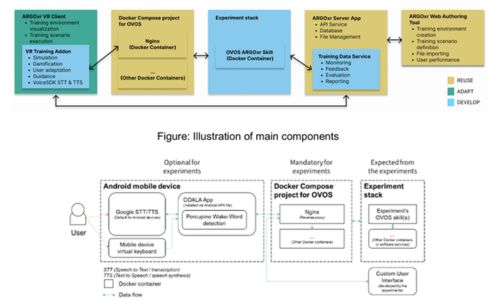
The main building blocks of the Digital Intelligence Assistant (DIA) are speech-to-text (SST) and text-to-speech (TTS). These technologies recommend voice interaction between humans and machines, which is especially important in manufacturing environment, where manual interaction with digital interfaces is often not optimal. SST enables the conversion of spoken language into digital text. The ONBOARDING-AI project uses the open source OpenVoiceOS (OVOS) platform, which includes support for various SST engines (e.g. Vosk, DeepSpeech). The system is designed to allow local or cloud processing. TTS on the other hand, allows a digital assistant to respond to the user in the form of spoken language. In our experiment, ONBOARDING-AI, this component is particularly important for real-time instruction, warnings or confirmation of commands. This significantly contributes to creating a more natural and intuitive user experience. With this approach, the ONBOARDING-AI provides a robust, flexible and open-source voice interaction system that is also suitable for manufacturing environments.
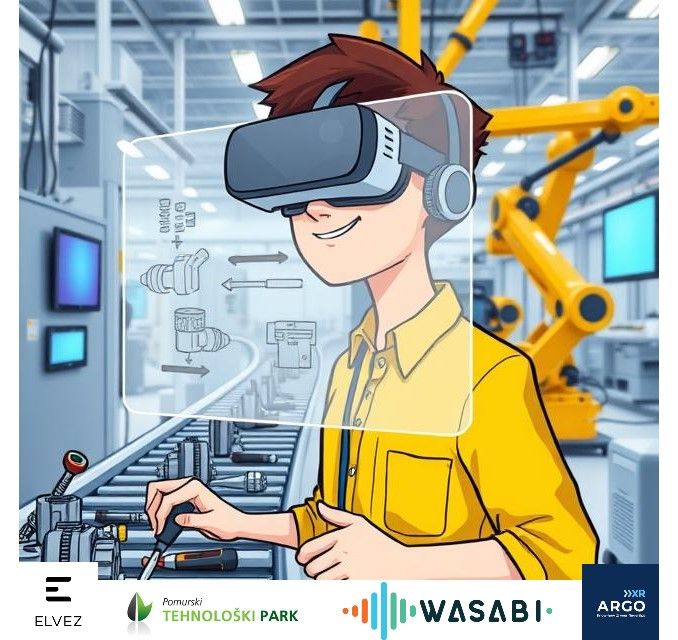
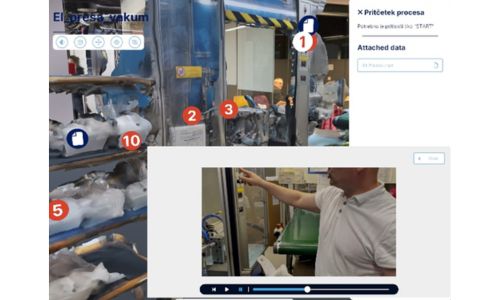
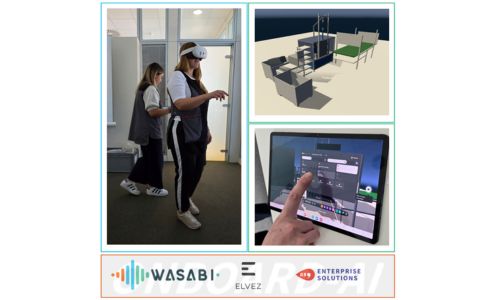
AI-driven chatbot and virtual assistants are being implemented into the platform to help trainees navigate through tasks, answer questions, and adapt the training content based on individual process. The platform also features visual guides, video tutorials, and interactive exercises to help trainees develop new skills and knowledge for their future roles. For the training, we used Meta Quest 3 VR Headset.
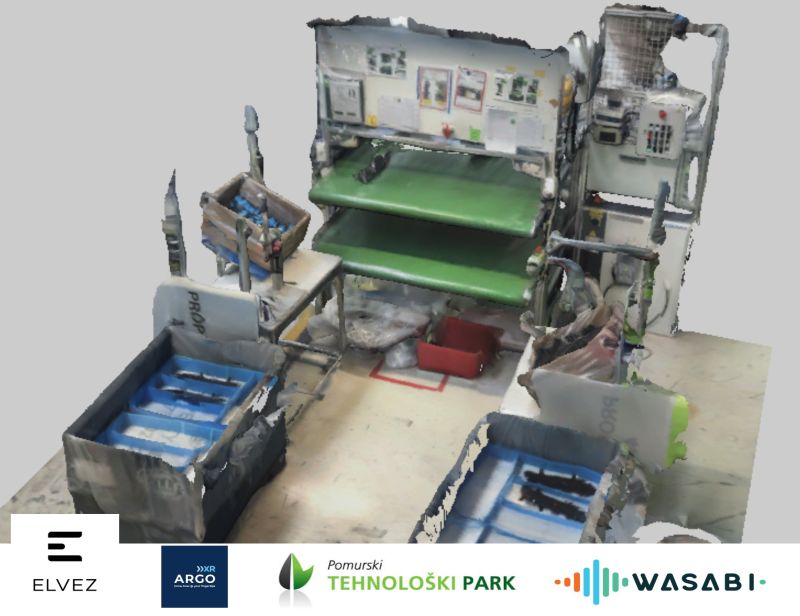
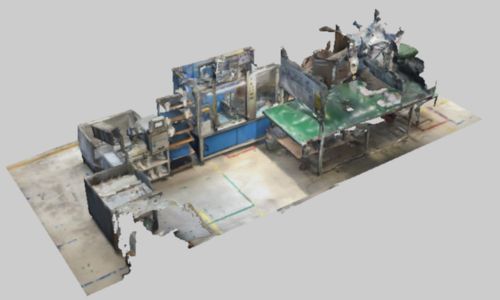
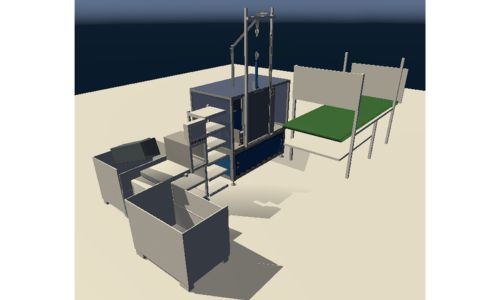
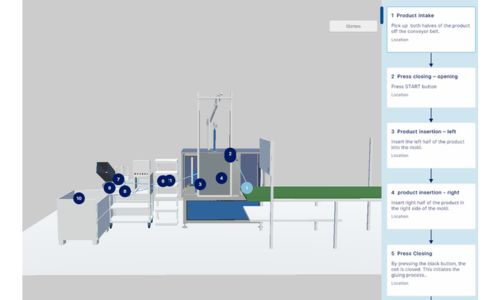
The VR training scenarios follow a structured sequence of steps that mirror the actual workflow within the production environment in ELVEZ. The designing phase of the experiment included capturing spaces in ELVEZ with a 3D camera by ARGOxr team, that followed editing the captured space of the equipment in the production floor with 3D virtual environment editors. The prototype presented clearly defined areas and functional zones designed to simulate the actual operational conditions and workflows. The main elements of the prototype included almost all planned key points for the final version of the solution:
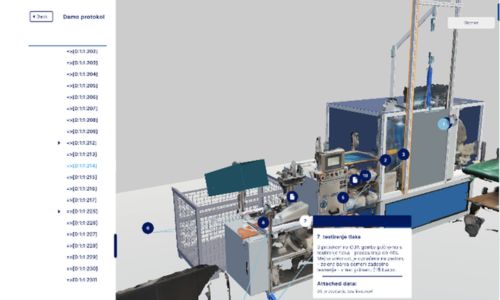
Machine operation zone – conveyor belt for part-handling, machine for hot-plate welding, machine for tightness testing, quality control points, and packing of the product. All machines, tools, and equipment are modeled with a high degree of realism, closely reflecting all physical counterparts. The prototype and the final version also include interactive and movable elements – such as functional buttons, welding tool mechanisms, and rotating parts to simulate real machine behavior and usage.
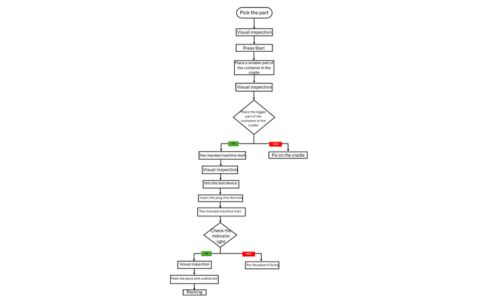
To outline all steps of the process, and to help the training participant, systematically learn and remember the flow of the operations, we first created a flowchart. These diagrams represent a sequence of the steps that a user must follow to perform certain tasks, allowing for an accurate simulation of a real-world environment. The correctness of the work operation then depends on the decision made by the individual.
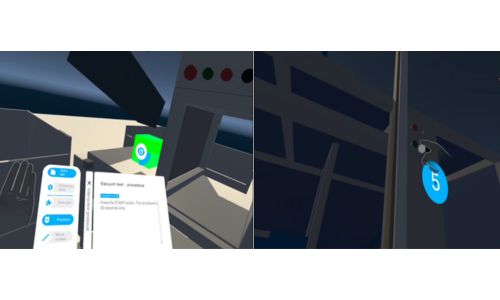
The VR training environment incorporates intuitive user interactions through hand gestures and feedback systems. These interactions allow employees to perform realistic tasks such as picking parts, operating machines, press buttons to stars certain action, and handling tools within the virtual workspace. Also, the voice command system allowed hand-free workflow, which helped participants navigate effectively in the virtual working environment.
ELVEZ operates within a labor market that is increasingly diverse in terms of age, educational background, and linguistic capability. Differences in prior technical experience and digital literacy often lead to unequal onboarding outcomes. By enabling immersive VR training with real-time voice interaction, ONBOARDING-AI provides a controlled, supportive environment that can adapt to individual abilities and learning speed. Local, client speech processing reduces the need for high language proficiency to interact with the system, enabling more equitable access for multilingual or nonnative speakers.
Usability and effectiveness tests will be carried out in ELVEZ. We have selected 10 participants for the testing phase, 5 of whom will be trained traditionally and 5 in a VR environment.
By the end of the experiment, ELVEZ will have fully integrated digital training system that optimizes onboarding, reduces errors, and enhances worker competence, ultimately contributing to more efficient and sustainable production processes. Through digital, simulation-based training, we also contribute to sustainability by reducing the need for physical training materials and lowering the occurrence of mistakes on the production line.
THE EXPERIMENT WILL DELIVER:
Being a part of the automotive industry, we are subject to a range of legal and regulatory frameworks relating to labor law, workplace safety, data protection, product quality, and constructural compliance within the automotive standards. As a European SME, we operate in accordance with national and European labour legislation, which covers everything from recruitment to induction, equal treatment, skills development and employee rights, and obliges us to provide adequate and verifiable training, including safety instructions, before employees take on specific production tasks.
These legal aspects impact the design, operation and deployment of the proposed digital solution. Therefore, the trial must be aligned with applicable legal obligations to ensure safe, ethical and compliant implementation.
The onboarding process relied primarily on traditional training, a hands-on knowledge transfer, leading to creating variability in training quality. Mostly informal, with senior workers transmitting skills through demonstrations and written/oral instructions. Training materials and communication are often in the native language, which can be a barrier for non-native speakers. This often resulted in errors, inconsistent delivery, material loss and increased workload.
MOTIVATION FOR APPLYING
- Design and deploy an interactive digital training platform utilizing Conversational AI and HMI that mimics real-world manufacturing tasks, focusing on plastic injection molding and wire harness assembly. The created virtual platform will allow trainees to practice procedures, troubleshoot scenarios, and build confidence in a safe and controlled environment.
- Create a training module in VR, integrating visual tools such as step-by-step video tutorials, incorporating gamified solutions that reward accuracy, speed, and adherence to standard operating procedures.
- Implement a feedback mechanism through AI-driven analytics to track trainee performance and adapt training content in real-time. These tools will also help measure the effectiveness of the training platform and identify areas for improvement. Performance metrics such as task completion time, accuracy, and safety in the testing environment will be continuously monitored through simulation (VR cast) on a tablet device.
The experiment will be conducted at ELVEZ, a manufacturing SME based in Višnja Gora, Slovenia, which specializes in producing high‑quality automotive components. The company operates two main production lines: injection molding of complex plastic parts and assembly of cable harnesses. The initial phase of the experiment focuses on a work procedure within the injection‑molding production line, where operators are responsible for assembling intricate plastic components. In a later phase, the experiment will expand to include the development of a new training program dedicated to the production of cable harnesses and assemblies.
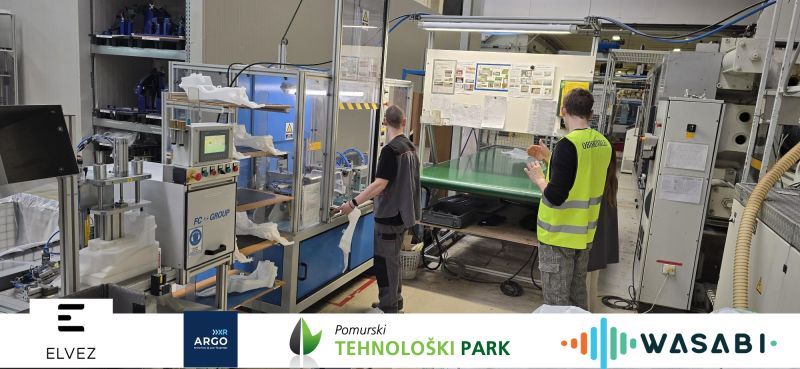
The experiment will take place directly on the injection molding production floor at ELVEZ, representing a real industrial environment rather than a laboratory or pilot setting. This environment includes multiple injection molding machines, welding and assembly equipment, and testing stations used for quality control. The goal is to evaluate the solution under real production conditions (TRL6), where operators must work with precision and adhere to established procedures. On the production floor, we have established a dedicated clean and controlled area specifically prepared for safe VR‑based training. This space ensures that operators can participate in immersive training sessions without interfering with ongoing production activities and while maintaining all required safety standards. Before participating in the training, individuals must complete a questionnaire specifically designed to determine whether they are suitable for using VR technology. This assessment helps ensure that participants can safely and comfortably engage with immersive training tools. In addition, each individual participant is given the opportunity to choose whether they prefer to take part in the VR-based training program or follow the traditional training approach, allowing them to choose what method best aligns with their comfort level and learning preferences.
The use case is based on a multi‑step procedure in which an operator is required to produce a fully functional injection‑molded plastic part. The component is manufactured in two separate pieces that must be joined through a precise welding process. Operators must follow detailed instructions and perform several critical tasks, such as correctly positioning parts in the cradle, executing the welding operation, testing the components for tightness, inspecting them for defects, and marking and documenting the finished parts. Common errors observed among operators include incorrect placement of parts, insufficient or omitted tightness testing, failure to identify defects in components or assemblies, and incorrect marking or documentation, which can lead to quality‑control issues.
The primary users involved in the experiment are production operators, particularly newly hired employees who often face challenges due to the complexity of the processes. Additional stakeholders include shift leaders and supervisors who oversee daily operations, quality assurance personnel responsible for maintaining product standards, process engineers who design and optimize workflows, and company management. Customers in the automotive supply chain also indirectly benefit from improved process reliability and product quality.
The experiment must comply with several operational and regulatory constraints. These include adherence to automotive industry safety and quality standards such as IATF 16949, compliance with machine safety regulations for working near injection molding and welding equipment, and meeting certification requirements for operators performing specialized tasks.
Access to production data may be restricted due to proprietary or customer‑sensitive information, and the solution must integrate with existing digital systems such as manufacturing execution systems and quality‑tracking tools. Additionally, production lines have limited availability for downtime, which requires careful planning to avoid disruptions.
The experiment is expected to result in significant improvements in training effectiveness, operational quality, and workforce readiness within the ELVEZ production environment. While improving the training effectiveness with the VR technology solution, we also expect that the adoption of advanced Digital Intelligent Assistant systems will modernize our manufacturing processes, improving accuracy in assembly and enhancing the capability for complex wire harness production. This is expected to result in reduced training costs and increased productivity, strengthening our competitive edge potentially attracting new clients.
By introducing VR‑based training for complex injection‑molding procedures, we anticipate a measurable reduction in operator errors, particularly among newly employed individuals who often struggle with the complexity of the tasks. The immersive nature of VR training is expected to enhance knowledge retention, improve procedural accuracy, and increase operator confidence before they begin working on the production line.
Success of the individuals will be evaluated through a combination of key performance indicators. Key performance metrics will include the reduction of common operator mistakes, such as incorrect decisions made during the process, incomplete tasks, failure to identify defects, and inaccurate marking of finished components. Additional indicators of success will include shorter onboarding times, fewer interventions required by supervisors, and improved consistency in following established work instructions. Feedback from operators, supervisors, and quality assurance personnel will also play an important role in assessing the perceived usefulness and usability of the training program.
The experiment is expected to benefit a wide range of stakeholders. Operators will gain a safer, more engaging, and more effective learning experience, while supervisors and quality teams will benefit from a more reliable and better‑prepared workforce.
ELVEZ on the other hand, will gain insights into how advanced training technologies can support productivity, reduce scrap rates, and improve overall process stability. In the later phase, when the training program expands to cable harness production, the company will be able to apply the same methodology to another critical area of its operations.
There are also potential sustainability benefits. By improving operator accuracy and reducing the number of defective or improperly assembled components, the experiment can contribute to lower material waste and reduced energy consumption associated with rework. More efficient training processes may also reduce the need for repeated physical demonstrations, saving time and resources.