Calie
EXPERIMENT OVERVIEW
The CALIE experiment (Conversational Assistant for Logistics and Inventory Enhancement) aims to design, develop and validate a voice-enabled Digital Intelligent Assistant integrated into real manufacturing logistics operations. The experiment addresses a common challenge in small and medium-sized manufacturing enterprises: the strong dependency on manual data entry and screen-based interactions in warehouse and inventory processes, which often results in delays, human errors, and increased cognitive load for operators.
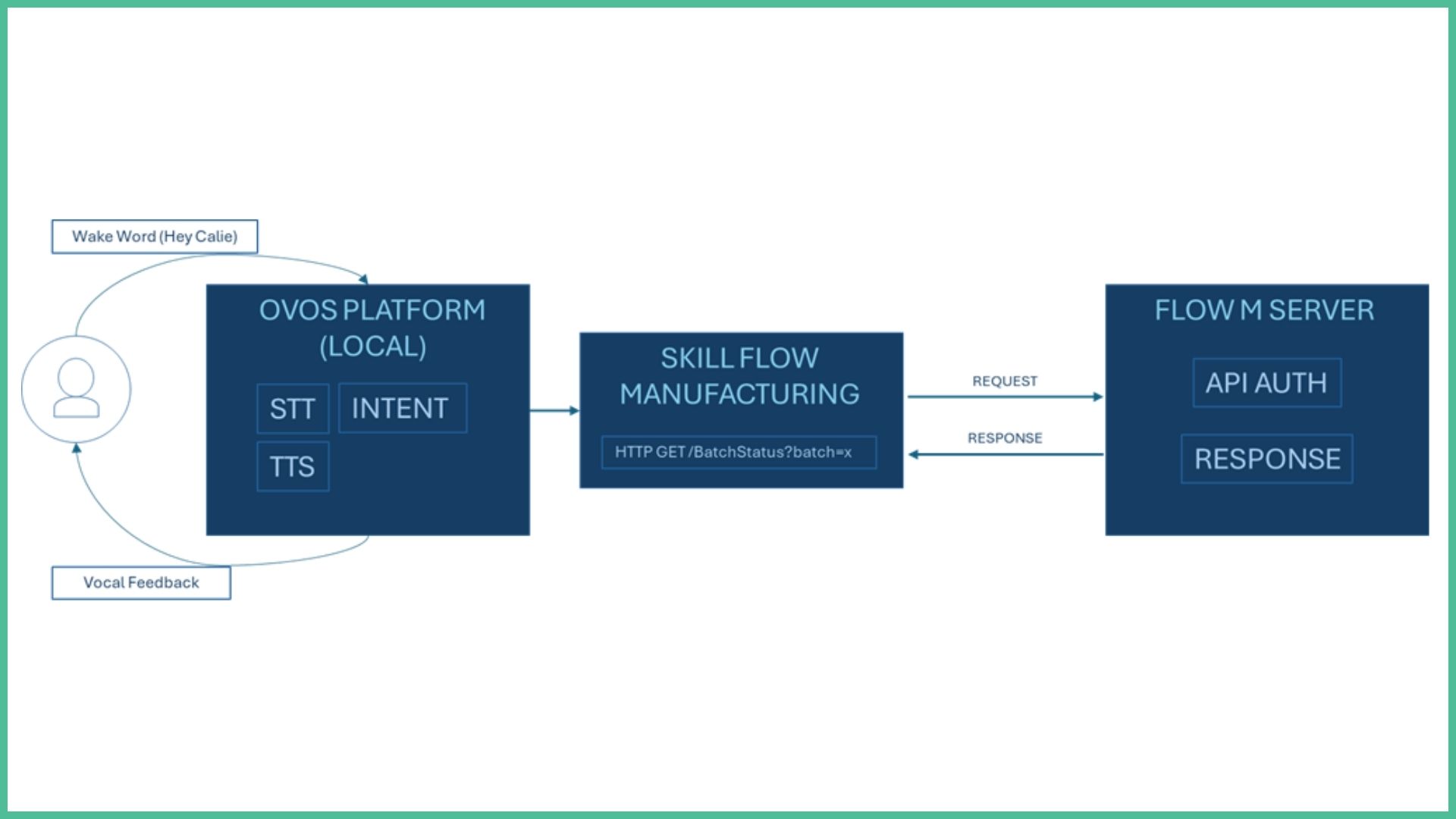
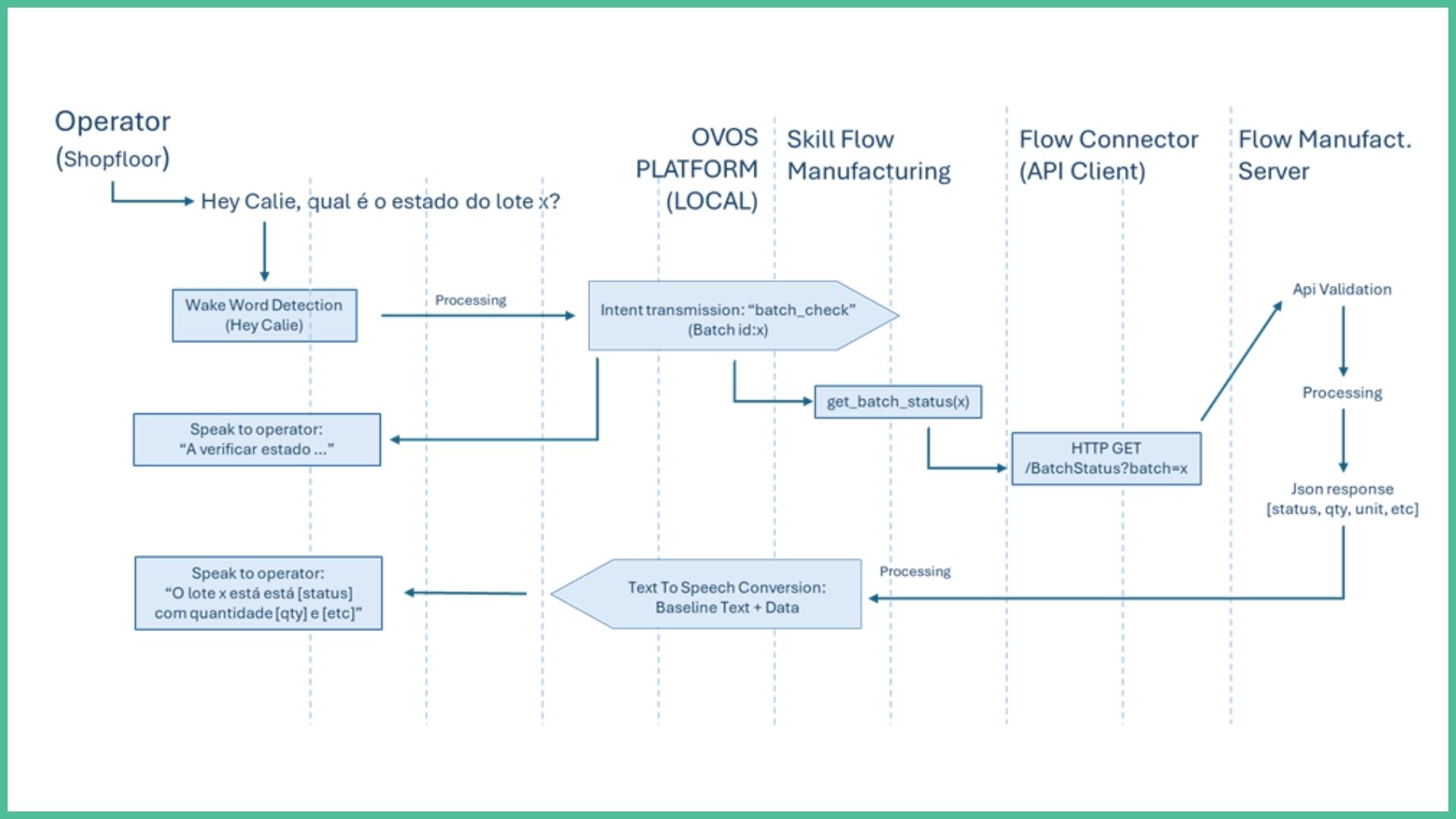
Within the experiment, a conversational assistant will be developed as an OVOS-based skill and integrated into the Flow Manufacturing (Flow M) execution system used by Conservas Pinhais & Cia. The assistant will allow operators to interact with logistics and inventory modules using natural voice commands, enabling hands-free execution of key processes such as goods reception, stock movements, picking operations and inventory counting. Voice interactions will be processed through a modular architecture based on open standards and containerised deployment, ensuring interoperability, reproducibility and scalability.
The solution will be deployed and validated in a real factory environment at the Pinhais production site in Portugal. Operators will use the assistant during daily logistics activities, allowing the consortium to measure concrete improvements in efficiency, accuracy, and user satisfaction. The experiment will demonstrate how conversational artificial intelligence can support industrial workers in complex workflows, reducing execution time, minimizing errors, and improving overall working conditions.
Beyond the local pilot, CALIE is designed with replication in mind. The developed assistant will be packaged and published in the WASABI White Label Shop, making it accessible to other manufacturing SMEs interested in adopting voice-enabled digital assistance. By combining industrial validation, open-source conversational AI technologies, and a marketplace-based distribution model, the experiment contributes both to the digital transformation of Conservas Pinhais & Cia and to the broader WASABI ecosystem.
The relevance of the experiment lies in its potential to make manufacturing processes more agile, reduce operational inefficiencies, and enhance the attractiveness of industrial jobs through intuitive and human-centric interaction with digital systems.
Manufacturing SMEs, particularly in sectors with intensive logistics and traceability requirements such as food production, still rely heavily on manual data entry and screen-based interfaces for warehouse and inventory operations. Operators frequently need to interrupt physical tasks to input information into terminals, scan codes, or navigate complex software menus. This constant switching between physical handling and digital interaction increases execution time, creates opportunities for human error, and adds cognitive strain to workers.
In the case of Conservas Pinhais & Cia, logistics processes such as goods reception, picking preparation, stock movements and inventory counting require precise data registration to ensure traceability, compliance with food safety standards, and accurate stock control. Even small registration errors can lead to discrepancies in inventory levels, delays in order fulfilment, and additional verification procedures. In regulated environments such as the agri-food sector, maintaining accuracy and auditability is essential, making reliable data capture a critical operational requirement.
Another significant challenge relates to workforce onboarding and training. Traditional Manufacturing Execution Systems often require structured training before operators become fully autonomous. This creates a dependency on experienced staff and extends the learning curve for new employees. In a context where SMEs face increasing labour shortages and the need for higher operational agility, simplifying interaction with digital systems becomes a strategic priority.
From a technological perspective, integrating conversational artificial intelligence into industrial systems also presents challenges. Voice recognition must operate reliably in noisy factory environments, system integration must be secure and interoperable with existing software, and data handling must comply with European data protection regulations. Ensuring transparency, user control, and GDPR-compliant data management is fundamental when introducing AI-based assistance into operational workflows.
The CALIE experiment addresses these combined operational, organisational, and technological challenges by rethinking how workers interact with digital systems in logistics and inventory management, moving from screen-based input to natural, voice-enabled interaction while preserving traceability, compliance, and system reliability.
Objective 1:
Design and develop a voice-enabled Digital Intelligent Assistant integrated with the Flow Manufacturing system, enabling operators to execute logistics and inventory tasks through natural language interaction in a secure, modular and interoperable architecture aligned with the WASABI framework.
Objective 2:
Deploy and validate the assistant in real factory operations at Conservas Pinhais & Cia, demonstrating measurable improvements in logistics performance, including reduction of human errors, faster task execution, increased productivity, reduced training effort and improved operator satisfaction.
Objective 3:
Package and publish the developed conversational skill in the WASABI White Label Shop, ensuring replicability, scalability and accessibility for other manufacturing SMEs interested in adopting human-centric AI solutions for logistics and inventory management.
The CALIE experiment is implemented in the agri-food manufacturing sector, specifically in canned fish production. Conservas Pinhais & Cia operates a traditional yet export-oriented manufacturing facility in Portugal, where logistics, traceability, and inventory control are critical to daily operations. The experiment will be carried out directly at the company’s production and warehouse site, in a real operational environment rather than a laboratory setting.
The assistant will be deployed within the existing logistics and inventory workflows supported by the Flow Manufacturing system. The operational environment includes goods reception areas, storage facilities, picking preparation zones, and inventory control processes. These activities involve frequent material handling, barcode scanning, stock confirmations, and data registration tasks that must comply with strict traceability and food safety requirements.
The primary users of the solution are warehouse operators, logistics staff, and supervisors responsible for stock accuracy and order preparation. The system must therefore operate reliably in a factory environment characterised by background noise, movement, and time-sensitive operations. Usability, clarity of voice interaction, and minimal disruption to existing workflows are key considerations.
The experiment must also comply with regulatory and operational constraints. As a food manufacturing company, Conservas Pinhais & Cia follows strict food safety and traceability standards, requiring accurate and auditable data registration. In addition, the solution must ensure secure authentication, controlled access to operational data, and full compliance with European data protection regulations. Integration with the existing Flow Manufacturing system must preserve data integrity and ensure real-time synchronisation of inventory records.
By deploying the conversational assistant in a live manufacturing setting, the experiment demonstrates how voice-enabled interaction can be embedded into real industrial workflows without compromising compliance, traceability, or operational reliability.
EXPECTED IMPACT
EXPECTED IMPACT
The CALIE experiment is expected to generate measurable improvements in logistics efficiency, operational accuracy, and workforce experience within the manufacturing environment of Conservas Pinhais & Cia. By introducing natural voice interaction into inventory and warehouse processes, the experiment aims to reduce friction between physical operations and digital systems, resulting in more agile and reliable workflows.
Success will be assessed through clearly defined Key Performance Indicators (KPIs), measured during the pilot phase and compared against established operational baselines. The experiment targets a reduction of at least 25% in human registration errors (baseline: approximately 8 errors per 100 operations), a 20% reduction in average execution time of logistics tasks (baseline: approximately 5 minutes per task), and a 15% increase in operator productivity (baseline: approximately 12 boxes processed per hour). In addition, the experiment aims to reduce operator training time by 30% and to improve overall operator satisfaction by at least 20%, as measured through structured feedback surveys.
For end users, the expected benefits include faster task execution, fewer manual interruptions, improved accuracy in stock management, and a more intuitive interaction with digital systems. By enabling hands-free operations, the assistant can also contribute to improved ergonomics and reduced cognitive load, supporting safer and more user-friendly working conditions.
From a business perspective, improved stock accuracy and reduced operational errors contribute to better traceability, lower rework rates, and more reliable order fulfilment. These improvements strengthen the company’s competitiveness in export markets, where compliance, precision and responsiveness are essential.
Beyond the individual SME, the experiment also contributes to sustainability and scalability objectives. By optimising logistics processes and reducing inefficiencies, the solution supports more resource-efficient operations. The publication of the conversational skill in the WASABI White Label Shop further enables other manufacturing SMEs to adopt and adapt the solution, amplifying its impact across the European manufacturing ecosystem.
The experiment will be considered successful if the defined KPIs are achieved during real-world validation and if the developed assistant is successfully packaged, published, and made accessible for replication through the WASABI marketplace.
GALLERY